This karmic debt number calculator reveals what most people never see — karmic debt is not punishment, it’s a numerology pattern drawn from your date of birth data. Hans
Any core numerology calculation pausing at a pre-reduction stage of 13, 14, 16, or 19 marks a karmic debt — a carried forward lesson carrying repayment weight that reduces to a single digit across your charts.
What Is a Karmic Debt Number?
A karmic debt number reveals a pattern of tendency carried across lifetimes, embedded within your core numerology charts. These four specific totals signal unresolved balance work demanding conscious life attention.
Unlike ordinary numbers, karmic debt signals appear when a two-digit total preceding your core number matches 13, 14, 16, or 19 — flagging a tendency toward life lessons requiring deliberate balance realignment.
The Four Karmic Debt Numbers: 13, 14, 16, and 19
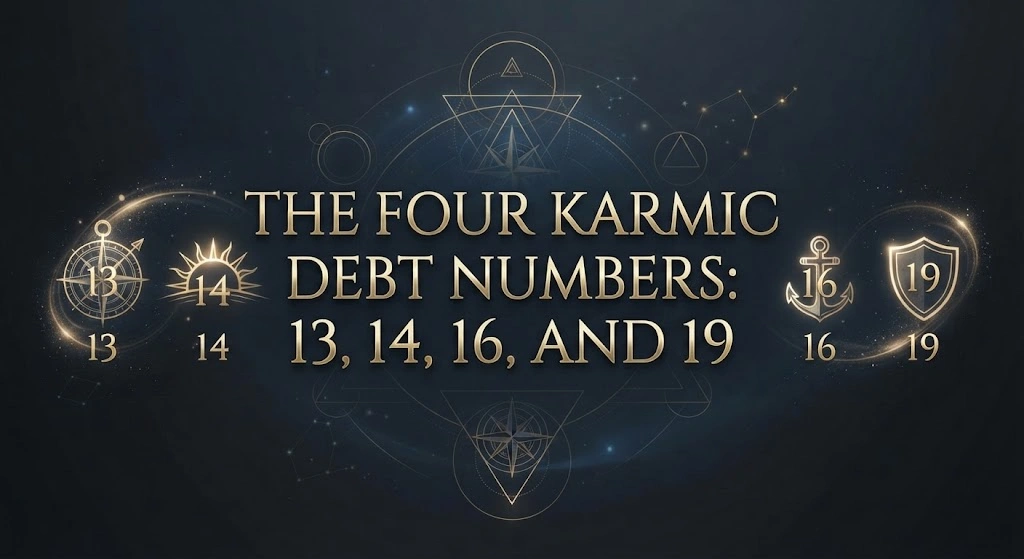
Each karmic debt number carries a distinct pattern rooted in old imbalance — 13/4 demands honest, focused, patient effort over shortcuts; 14/5 confronts scattered energy and restless appetites requiring moderation; 16/7 dismantles ego through collapse and humility; 19/1 tests power and self-sufficiency.
These four debts aren’t punishment — each functions as a repayable behavioral tendency, a steering mechanism embedded within core numbers. Working consciously through debt of freedom, debt of work, or debt of power gradually dissolves the resistance each number carries.
The 13/4 — Hard Work and Shortcuts / Karmic Debt 13: The Debt of Work
Those carrying 13/4 often discover that shortcuts lead nowhere sustainable. The karmic debt demands consistent effort — not punishment, but recalibration. Genuine discipline rewires the soul toward building something lasting through honest, focused work.
Frustration visits frequently when 13 appears in a core position. Yet 4‘s stabilizing energy rewards persistence. Each avoided task compounds the debt; each commitment honored quietly dissolves what once felt like an impossible, immovable structural burden.
The 14/5 — Freedom and Moderation / Karmic Debt 14: The Debt of Freedom
Those carrying 14/5 often discover that freedom, pursued carelessly, quietly dismantles itself. Indulgence treated as liberation becomes its own prison — each excess narrowing the authentic space genuine independence actually requires to breathe and expand.
Moderation here isn’t restriction but recalibration. The 5 energy craves movement, yet 14 demands accountability — learning that sustainable choices build the only freedom worth keeping, earned through conscious, deliberate restraint rather than impulse.
The 16/7 — Ego and Renewal / Karmic Debt 16: The Fallen Tower
The 16/7 carries a dismantling energy unlike any other debt — structures built on pride or illusion eventually collapse, not as punishment, but as correction. Renewal arrives only after ego releases its grip on what felt certain.
Those carrying 16 often experience sudden reversals — relationships, careers, identity itself — stripped to reveal what was never solid. The lesson isn’t destruction; it’s learning to rebuild on authentic ground rather than constructed appearances.
The 19/1 — Power and Others / Karmic Debt 19: The Debt of Power
Those carrying 19/1 often discover that independence, wielded without regard for others, quietly hollows out every accomplishment. True leadership doesn’t emerge from isolation — it demands acknowledging the interdependence woven into every meaningful rise.
Real authority here isn’t seized through control but earned by recognizing where self-reliance crossed into dismissiveness. The 19 pattern corrects by placing you in situations demanding cooperation, humility, and the willingness to receive as openly as you give.
How the Karmic Debt Number Is Calculated
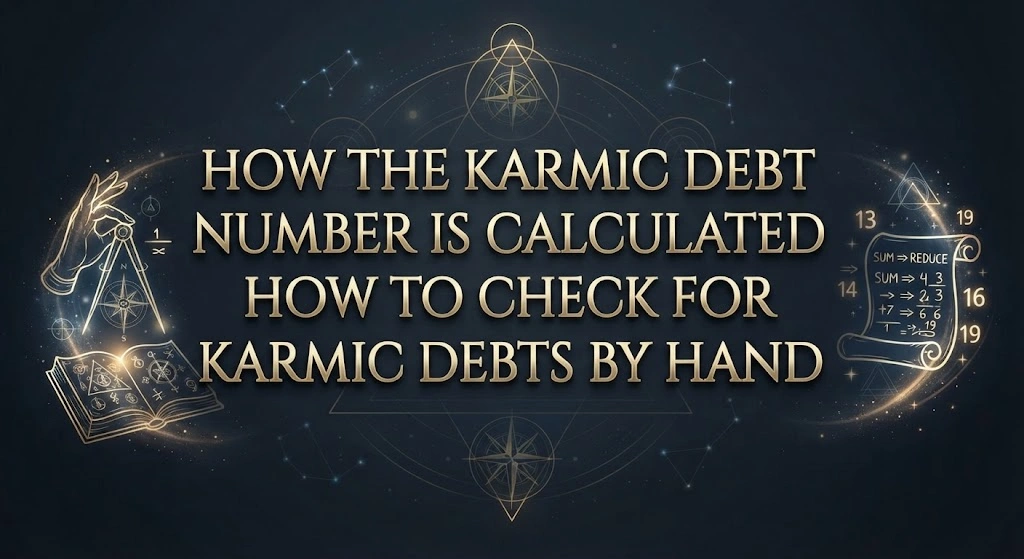
To calculate your core number, reduce your birth month, day, and year separately, then add the three results. During last reduction, stop and compare each sub-lesson total — debts match numbers 13th, 14th, 16th, or 19th.
Check whether you were born on a birth day carrying a debt. Carry each intermediate step forward; your Life Path‘s final total reveals hidden obligations. Never skip the month — every digit matters here.
Step-by-Step Method
Most practitioners pause before they reduce — and that hesitation matters. Each position demands its own check: isolate the month, day, and year separately, noting the last total before collapsing into a single number.
The Birth Day and four Pinnacle numbers each require independent reduction, tracking intermediate steps carefully. A matching pre-reduction figure — 13, 14, 16, or 19 — signals debt attached to that core number, revealing karmic pattern assignment.
Worked Example: Born January 23, 1988
To calculate the Life Path for this date of birth, add each unit separately. The birth day is 23, which reduces to 5. January gives 1, and 1988 is a four-digit year.
The year 1988 reduces through 1+9+8+8 = 26, then 2+6 = 8. Now sum all final units: 1 + 5 + 8 = 14, a genuine Karmic Debt total before reaching its single digit, 5.
Name Numbers Work the Same Way

Your full birth name holds digits practitioners rarely discuss openly. Convert each letter to its number, then examine totals across core number positions — debt signatures embedded in name calculations reveal missing karmic assignments surprisingly often.
Expression, Soul Urge, and Personality positions derived from name each carry independent numerology weight. A two-digit total of 13, 14, 16, or 19 appearing here signals debts demanding the same rigorous attention as Life Path calculations.
What to Do With a Karmic Debt Number
Once you identify a karmic debt in your chart, the real work begins — not avoidance. Treat it as a starting position, not a fixed sentence. Your Life Path number still sets the destination; the debt just signals a steeper on-ramp.
Consciously engaging the debt’s theme over time matters more than the number itself. Working through it — rather than avoided patterns — gradually dissolves its grip. By midlife, many reach balanced expression, where once-difficult traits become second nature, per classical sources.
Numerology vs. the Vedic View of Karma
Western Pythagorean numerology treats karma through a different lens entirely — reduction totals, not planetary positions. The system assigns view through numbers alone, no birth chart required, making it structurally distinct from Eastern traditions.
Vedic Jyotish tracks karmic debt through Saturn, Pitra Dosha, the 5th house, and the Rahu-Ketu axis — celestial idea mapped astronomically. Both frameworks pursue accountability; neither approach is superior, just operating through different inherited vocabularies.
Sources & Further Reading
Classical numerology texts treat karmic debt as a separate idea from Vedic astrology, where karma carries a broader theme tied to life cycles and rebirth rather than fixed reduction to a single number.
Practitioners exploring debts, Life Path, Expression, and Soul Urge calculations recommend cross-referencing independent toolkit resources, as combination reading of two systems deepens understanding beyond what any single chart prompt offers.
Where Karmic Debts Hide in Your Chart
Most practitioners overlook that karmic debt numbers don’t exclusively attach to your Life Path. They surface across five places — wherever a final total before reduction lands on 13th, 14th, 16th, or 19th, matching debt patterns emerge.
Your birth day, the day of month you were born, plus four totals carried through each calculator position reveal an honest, clean result — exposing two hidden half-recognized tensions most chart readings casually miss entirely.
Frequently Asked Questions
Q: Which Numbers Are Karmic Debt Numbers?
Karmic debt numbers are 13, 16, 19, and 14 — four specific figures that numerology flags as carrying extra assignment beyond an ordinary number’s practical meaning. Each signals a particular unresolved past tendency.
Unlike master numbers like 11, 22, or 33, these aren’t elevated — they represent effort still owed. Their finished result after reduction reveals a separate layer, a tendency classical sources describe as a difficult karmic range requiring conscious steering.
Q: What Positions Does This Calculator Check?
This calculator scans seven key positions across your numerology chart. Each location — from your Life Path to Pinnacle numbers — gets checked for karmic debt patterns using the reduction method.
Your Birth Day, Expression Number, Soul Urge, Personality Number, and Year Cycle totals all pass through this free tool. Any final total carrying 13, 14, 16, or 19 before reduction gets flagged immediately.
Q: What If I Don’t Have a Karmic Debt Number?
Not carrying a karmic debt number isn’t spiritual oversight — it’s actually common and normal. Your chart may show clean reading across all four specific patterns, signaling balanced prior-life energy without heavy debts.
A clean result doesn’t guarantee an easy life — it simply means your growth areas shift toward Karmic Lessons and Challenge Numbers instead. These signal different, equally incomplete yet rich chart territory worth exploring.
Q: Is the Karmic Debt Number From Vedic Astrology?
Many practitioners read this differently — numerology and Vedic astrology operate as different systems, each carrying its own cultural and interpretive lens. Karmic debt numbers belong strictly to Western numerology, not Jyotish.
Jyotish examines karma through Saturn, the Karma Karaka, the Rahu-Ketu axis, 5th house merit, and Pitra Dosha — lineage patterns tied to predictive, fixed fate mapping rather than personal guidance or reflection.
Q: Can I Get Rid of a Karmic Debt Number?
A karmic debt number isn’t a life sentence you’re permanently stuck with — it’s a pattern demanding conscious attention. Through sustained effort and honest self-examination, the friction it creates gradually eases as you engage its core lesson directly.
Many practitioners notice the weight lifts considerably around midlife, once balanced expression becomes second nature. The debt isn’t erased from your chart, but its grip loosens — what once felt punishing transforms into your most hardest-won victory and reliable insight.
Q: What If My Chart Shows No Karmic Debts?
Not every chart carries a debt, and that is actually the common case among practitioners I’ve reviewed. The absence of these numbers doesn’t signal something missing — your soul simply arrived without unfinished energetic obligations this cycle.
Some interpret a debt-free chart as ordinary, yet that reading sells it short. There is no lack here — only a particular configuration where growth unfolds through lessons, talents, and patterns rather than karmic correction work.
Q: Can a Karmic Debt Be Repaid?
Karmic debt doesn’t function like a financial balance you clear once and forget. Practitioners who track these numbers consistently find the pattern shifts — not disappears — when you engage the lesson directly and honestly.
Think of repayment less as erasure and more as mastery. The number stays; the friction it once created softens. That change in lived experience is the closest numerology comes to calling a debt settled.
Q: Can I Have Both Karmic Debts and Karmic Lessons?
Yes — and most people do. Karmic Debts and Karmic Lessons are similar-sounding terms that practitioners routinely mix up, yet they occupy entirely different corners of your chart. Karmic Debts arise from specific pre-reduction totals; Karmic Lessons emerge from digits absent in your full birth name. Both can coexist simultaneously on the same account.
Think of your numerology profile as a ledger: gaps between 1 and 9 where no letter-value lands signal Karmic Lessons — areas where natural skills remain underdeveloped. Debt and lessons operate on parallel tracks, each demanding separate attention without canceling the other out.
Q: Does a 13, 14, 16, or 19 in the Middle Steps Count?
Many practitioners wrestle with this. When a debt number surfaces mid-reduction, not at the final total, it still carries interpretive weight — the root number inherited that particular lesson from its past tendency before collapsing forward.
The four debt numbers each embed a verdict within intermediate totals. Spotting 13, 14, 16, or 19 mid-calculation signals a rebalance demand tied to that debt’s specific past tendency, even when the final digit reads clean.
Q: Is a Karmic Debt the Same as Bad Luck?
Karmic debt isn’t random misfortune — it carries weight rooted in numerology, not chance. Unlike bad luck, it follows patterns tied to specific life choices, demanding conscious work through recurring challenges until resolved.
Doom isn’t what karmic debt numbers signal — they forecast areas needing growth, not punishment. The direction they point is inward: identifying where avoidance, excess, or pride shaped past patterns that now quietly pulls at present circumstances.