
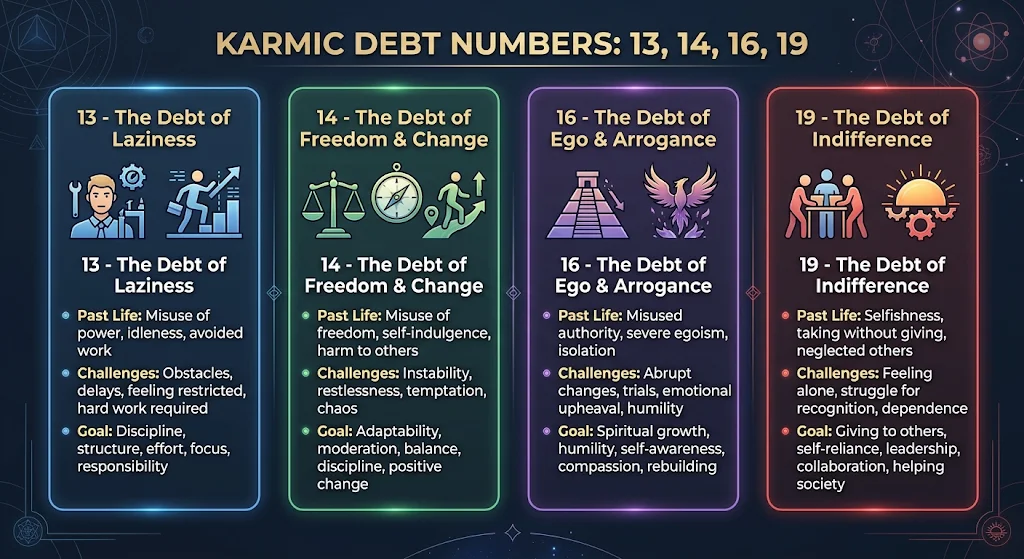
Karmic debt numbers are the two-digit compounds 13, 14, 16, and 19 that appear in a numerology chart before reduction, and most people never see them. Most people encounter numerology expecting simple single-digit readings, yet beneath every chart lies a two-digit stage far more revealing. The unreduced compound sum carries a pressure that the final reduction does not erase.
Each of 13, 14, 16, and 19 reduces to a root number: 4, 5, 7, and 1. In Indian numerology those roots are ruled by Rahu, Mercury, Ketu, and the Sun, so each compound carries its own planetary tone and its own lesson.
A karmic debt number works less like a verdict and more like a doorway: a concentrated pattern worth examining in this lifetime. Conscious engagement, not fear, shapes how that pressure plays out in daily life.
What separates karmic debt from ordinary karma is precision. Where general karmic tendencies feel shapeless, these four markers name a focused theme (discipline, freedom, humility, or service) written with heavier ink into your profile.
The four-number system originates in Western numerology, and Indian-numerology practitioners read the same compounds through planetary rulership. Both treat them as instruments for reflection, not punishments, and recognition alone begins the shift from unconscious repetition to conscious change.
What Are Karmic Debt Numbers?
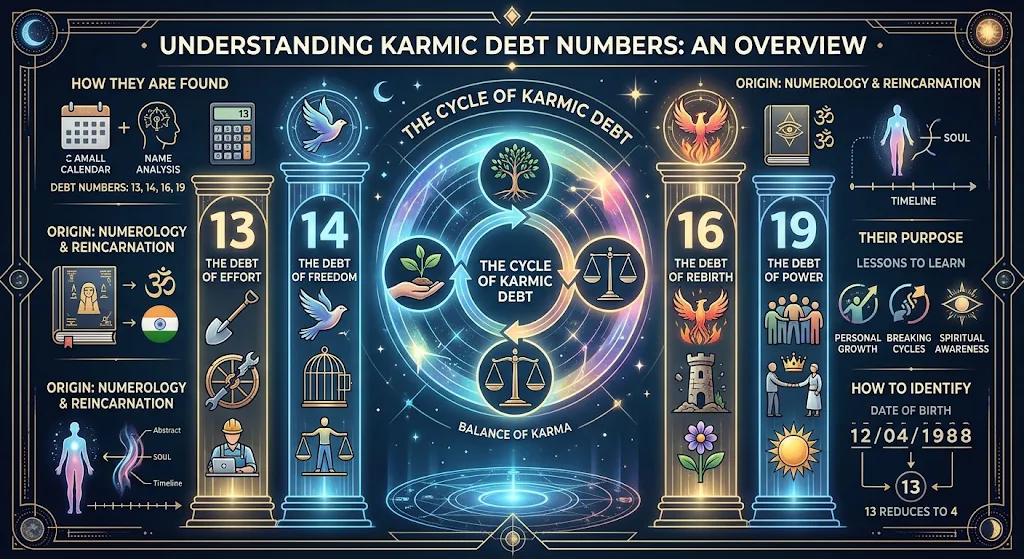
Karmic debt numbers appear when a two-digit compound such as 13, 14, 16, or 19 shows up before reduction in a chart. Traditionally they signal concentrated unfinished work carried forward.
The slash notation (13/4, 14/5, 16/7, 19/1) shows both the compound and its final reduction, a main lesson with a sub-lesson inside it. Keeping the unreduced number visible reveals the depth of the pattern.
In practice, repetition across Moolank (birth number), Bhagyank (destiny number), and Namank (name number) confirms emphasis. When 13 appears in several positions, it doesn’t mean a person is cursed. It points to one theme that keeps coming up.
The Theory of Karmic Debts
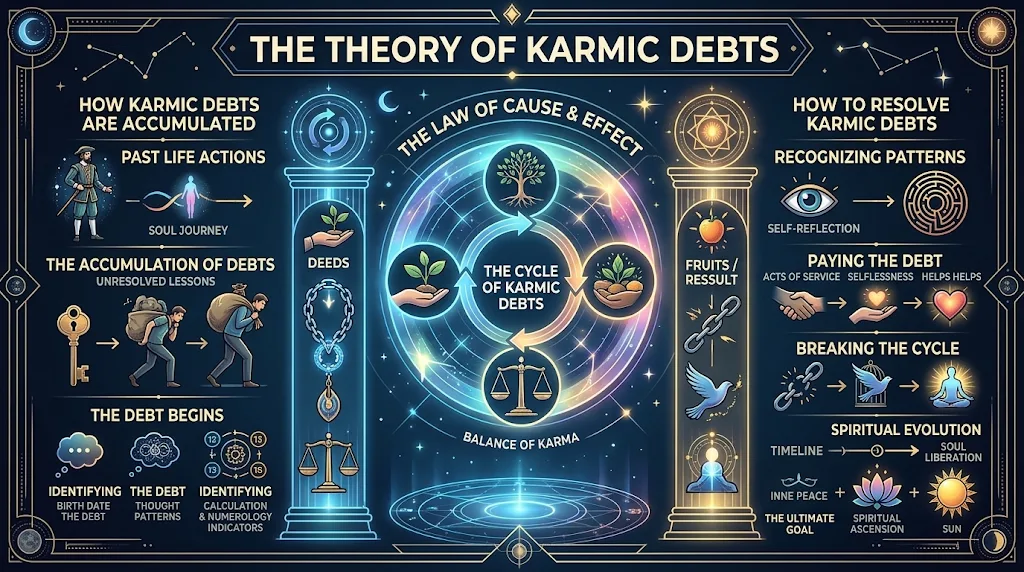
Most numerology systems treat karmic debts as concentrated lessons carried from another lifetime. The premise is simple: earlier actions create focused themes, and each compound number marks where those themes ask for conscious work now.
These indicators aren’t punitive. They are diagnostic, pointing to areas where steadiness works better than shortcuts.
Karmic Debt vs Karma in General
In Indian philosophy, karma is cause and effect: every action leaves an impression, a samskara, that ripples forward. Karmic debt numbers are not karma itself. They are a concentrated instrument within your chart.
Where general karma flows as a broad field of tendencies, a karmic debt is a compound pressure point, a specific theme coded into your unreduced calculation.
Think of karma as the whole field and karmic debt as one marked spot within it, where an unfinished lesson asks for mature participation.
How to Identify Karmic Debt in Your Chart
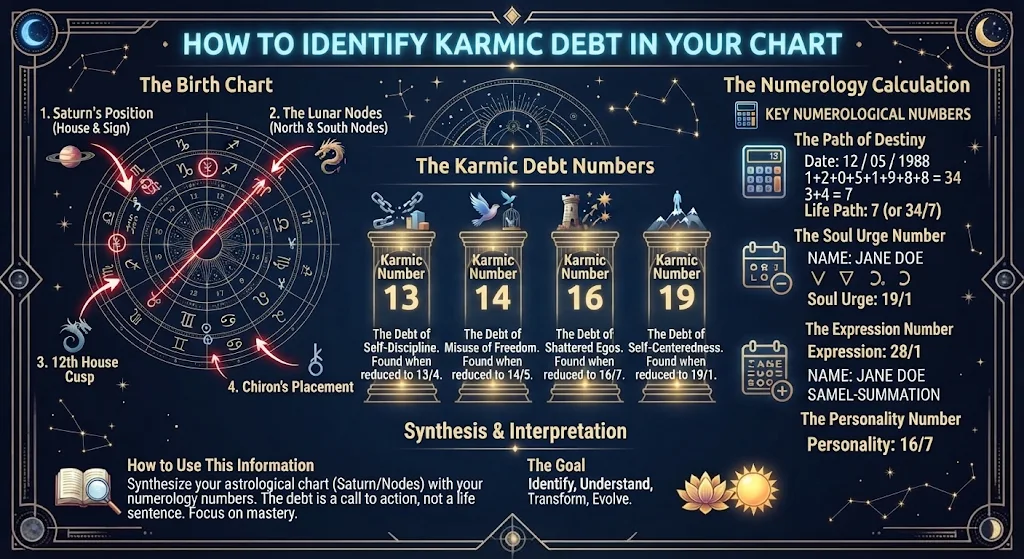
Start with three places: your day of birth, your Bhagyank, and your name. A birth day of 13, 14, 16, or 19 flags a debt directly.
For the full date, reduce the month, day, and year separately, add the three results, and watch that total before it collapses to a single digit. For example, 23 January 1988 gives 1 (month) + 5 (day) + 8 (year) = 14, which reduces to 5, so the debt is 14/5. A 13, 14, 16, or 19 at that stage marks a debt.
For names, convert letters using one system consistently (Chaldean in the Indian tradition, Pythagorean in the Western one) and check the unreduced total.
Cross-referencing themes across positions builds a practical picture. A compound that reduces to 4, 5, 7, or 1 is a prompt to reflect, not a prediction.
Want to check your own chart? Use our karmic debt number calculator to find your debt numbers step by step.
Working With Karmic Debt
Once you treat karmic debt as concentrated work rather than a verdict, something shifts. Steady practice across work, relationships, and habits tends to build real maturity.
Attention to recurring patterns reveals their source faster than any shortcut. These numbers are themes needing honest examination, not curses or fixed outcomes.
Approached with curiosity, these themes often become areas of real strength.
What Karmic Debt Is Not
Karmic debt carries a negative reputation it doesn’t deserve. It is not a verdict on your soul, and no one is tallying punishments. These numbers concentrate specific lessons that benefit from conscious practice.
Calling them curses misreads the idea. They are doorways, each inviting maturity rather than trapping you in repeating frustration.
Karmic debt is also not about laziness or casual bad choices. The framework sits beyond blame and points toward the lessons that still ask for honest, disciplined attention.
Karmic Debt 13/4
Karmic Debt 13/4 is traditionally linked to shortcuts and avoided effort. The pattern is one of wanting results without the sustained work behind them, and it is tied to Rahu’s restless energy.
Progress tends to stall whenever effort is skipped, and frustration shows up in career, study, and routine. That is the signal, not a punishment.
The lesson is patient, consistent work. The stabilizing energy of 4 rewards persistence, and each commitment honored quietly dissolves what once felt like an immovable burden.
Karmic Debt 14/5
Karmic Debt 14/5 is traditionally read as a pattern of excess: indulgence, restlessness, and freedom pursued without responsibility. Mercury’s quick, scattered energy amplifies it.
Temptation tends to repeat across career, relationships, and appetite. Disciplined freedom feels difficult, not from lack of strength, but because scattered focus is the default habit.
The old bargain was pleasure now, consequence later. The lesson is moderation, honest engagement with limits, and the understanding that lasting freedom is built through consistent effort, not impulse.
Karmic Debt 16/7
Karmic Debt 16/7 is the number most sensitive to ego. Traditionally it points to authority used for image over service, and it is tied to Ketu’s detaching energy.
Its lessons are not gentle. Reversals in status, relationships, or identity often arrive when pride is at its height, and they strip away what was never solid. The pattern asks for humility to replace a carefully defended self-image.
Steadiness comes through accountable, service-minded leadership. Interdependence, not standing alone, rebuilds this territory on authentic ground.
Karmic Debt 19/1
Karmic Debt 19/1 is traditionally read as authority misused: independence that dismissed other people’s needs while chasing personal power. The Sun governs this number.
The challenges tend to surface when the ego wants recognition without giving anything back. Humility is the central lesson.
Those who work with it honestly learn to lead through cooperation, to receive as openly as they give, and to build authority that earns respect rather than demanding it.
Frequently Asked Questions
Which numbers are karmic debt numbers?
Four compounds: 13, 14, 16, and 19, which reduce to 4, 5, 7, and 1. Treat them as a doorway into recurring patterns, never a verdict.
How do I know if I have a karmic debt number?
Check your birth day first. Then reduce your birth month, day, and year, add them, and watch the total before it collapses. Names add another layer: use one letter system consistently and compare the result with your lived patterns.
Are karmic debt numbers bad?
No. They describe a starting condition, not a fixed outcome. Shortcuts and ego inflation tend to create trouble, while humility, steadiness, and service soften it. Fear-language helps nobody.
Can karmic debt be removed or dissolved?
Not overnight, and not by purchase. A paid ritual or mantra is no guaranteed transaction. Change comes through noticing patterns and practicing new habits over years. The number stays, but its grip loosens.
What if I have multiple karmic debt numbers?
Cross-reference them patiently. Multiple debts often repeat one lesson across career, health, and family, so the domains differ but the work stays the same.